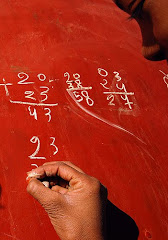
I have been thinking about the Amber Hill students a lot lately, in relation to my own teaching. I believed I had made significant changes to my instructional methodology but, since starting this course, a sneaky little voice inside my head ( that won't go away now no matter how much I try to ignore it) has been telling me differently. The connection between, the lack of true understanding exhibited by the students of Amber Hill, the style of teaching by AH teachers and my own practices has been in the fore front of my thoughts. The fact that I have introduced journals and portfolios, that I use a 'problem solving' approach for some lessons and to introduce concepts do not mean I am giving my students any greater understanding then the students of AH received. This has to stop! The realization came when I read some of what was contained in the"teachingmathematics4understanding' blog. This teacher has really got it going on. She has made a sweeping change and is in my opinion doing it the right way.
I don't know if my standard of "make changes at the rate I'm most comfortable with" stance is going to cut it for much longer. That said, the idea of making wholesale change in instructional style in the middle of a year, while doing a graduate course is daunting to me. Can I wait until this summer to plan in advance for how I want to begin? The answer is, I really shouldn't, but (and its a big one) can I do justice to the kind of changes needed at this point in time? I will continue to look for ways to make the mathematics in my classroom more inquiry based. I have already been doing that. Without Jo Boaler's work, this course and our discussions I would not have been able to see that I need to do more, and I will!
I have to add that the experiences in the classroom when the students are involved in discovery and exploration of mathematics are extremely fulfilling. I have never had such enthusiasm displayed for geometry before! I do know that I need to have greater knowledge of not only the big ideas behind the mathematics myself but greater ability to analyze student thinking. My inquiry project on professional development has become an exploration of what is out there and what I need. I am now feeling as though I must take over control of my own PD and find ways to support my own learning instead of passively waiting for whatever the next session offered by district or department is. The quality of the PD sessions delivered by the district are not in question, it is just that I have needs that are not being met and I am responsible for myself. Learn Sharon Learn!
Monday, November 16, 2009

Sunday, November 8, 2009
Interesting considering our upcoming discussion on chapter 9.


As I was searching for something else I came across this piece. I'm not even sure if it is a reliable statistic but it is interesting to me that someone could make the claim that gender issue in mathematics is gone. Below find link to the article that this visual came from.
http://www.epi.org/economic_snapshots/entry/webfeatures_snapshots_20080820/
Friday, November 6, 2009
Knowledge, Beliefs, and Mathematical Identities
I can't say I was surprised by the findings outlined in this chapter, it was already apparent where the true learning was taking place. I did enjoy, as usual, our discussion of the chapter, it was a well organized presentation for sure, the flow chart was exactly the right touch! It was what I had attempted to do in my own presentation but I couldn't get to work out the way I wanted, great job!
The effect that teachers have on students mathematical beliefs and knowledge is in some ways a little scary. In their attempt to simplify content the AH teachers caused unintentional harm to their students abilities, they could not solve problems without cues and could not apply knowledge to novel situations which required them to make connections between concepts. This is what we don't 'see' as we teach, since the development of mathematical beliefs and identities are ongoing and cumulative. What we do take as student learning, when we say, "yes they've got this" ( like Michelle expressed with her story about integers and bedmas) is generally not true at all. The more I read and hear in this course the more I realize that what we see in the classroom is that some (but not all) students can follow what I've taught and replicate it at that moment in time, but that this is not knowledge and it is definitely not understanding. We have all expressed experience with the "what is the matter with them [students] they knew this yesterday (last week, two weeks ago). Yet, like the AH teachers we didn't stop to really ask why or to connect lack of success with our teaching, "I understand it, my steps were clear... so they should understand it".
We need to strive for more than what we have accomplished in the past with our instruction. I know that having had the discussions this course work and this group has allowed I now find it impossible to ignore what I know has to be changed. I say ignore because at some level isn't that what we've all done when we notice student frustration or lack of recall, ignore the real reason behind it? What we want is to produce students who are "flexible with mathematics knowledge and are able to adapt and change", we want them to take a stance of inquiry that makes them see that exploring mathematics and connecting concepts is a natural process.
Now how do we do that exactly?
The effect that teachers have on students mathematical beliefs and knowledge is in some ways a little scary. In their attempt to simplify content the AH teachers caused unintentional harm to their students abilities, they could not solve problems without cues and could not apply knowledge to novel situations which required them to make connections between concepts. This is what we don't 'see' as we teach, since the development of mathematical beliefs and identities are ongoing and cumulative. What we do take as student learning, when we say, "yes they've got this" ( like Michelle expressed with her story about integers and bedmas) is generally not true at all. The more I read and hear in this course the more I realize that what we see in the classroom is that some (but not all) students can follow what I've taught and replicate it at that moment in time, but that this is not knowledge and it is definitely not understanding. We have all expressed experience with the "what is the matter with them [students] they knew this yesterday (last week, two weeks ago). Yet, like the AH teachers we didn't stop to really ask why or to connect lack of success with our teaching, "I understand it, my steps were clear... so they should understand it".
We need to strive for more than what we have accomplished in the past with our instruction. I know that having had the discussions this course work and this group has allowed I now find it impossible to ignore what I know has to be changed. I say ignore because at some level isn't that what we've all done when we notice student frustration or lack of recall, ignore the real reason behind it? What we want is to produce students who are "flexible with mathematics knowledge and are able to adapt and change", we want them to take a stance of inquiry that makes them see that exploring mathematics and connecting concepts is a natural process.
Now how do we do that exactly?
Sunday, November 1, 2009
Chapter 7 - Exploring the Differences
Krista, congratulations on a job well done! Great discussion provoking questions, they made me even more sure that I want to explore how Professional Development could be used to improve instruction.
Experiencing School Mathematics has taken us through introductions and explorations into the two schools (Amber Hill and Phoenix Park) and into discussions in detail of the results of assessments for both. Now in Chapter 7, Boaler lets us hear the voices of the students as we 'Explore the Differences'. Through a mix of analysis of assessment results and interviews with the students involved we are able to see the differences in the capabilities of the students in these schools.
This chapter brings together all we have learned about the differences in curriculum and teaching styles of AH and PP. It is the proverbial 'the proof is in the pudding' scenario. Amber Hill students were able to use math knowledge, in class, when questions contained cues which indicated which 'maths' to use and when questions (GCSE) were of the short answer type. However, these same students were unable to determine for themselves which math concept/rule/procedure was needed to find a solution unless directions were explicit. When Boaler says that the 'math competencies displayed in different situations reflected both their understanding of mathematics and the belief that the students had developed about mathematics" she is discussing the student mathematical capabilities and it is clearly evident that AH students had very few.
On the bottom of page 106 I was struck by the student comments as they reveal their own realizations of how difficult they found the exam questions. It was their first inkling that there was a problem with their understanding of mathematics. Although naturally they blamed the test questions and labeled them unfair. "It's stupid really ' cause when you're in the lesson,.... you get the odd one wrong... you think well when I go into the exam I'm gonna get most of the right,'cause you get all your chapters right, But you don't. ( Alan) To me as an observer Alan's comments are a poignant reminder of the insecurity and stress that students who have little understanding feel as they are being pushed through one grade/curriculum after another. My heart really did sink as I clearly remembered being in an exam and realizing I just didn't know how to proceed, it was not good for the self esteem.
Chapter 7 gives example after example of how damaging the traditional style of teaching is for students who participate in it. They are unable to make connections between math concepts and unable to connect math to the real world. All in all, I couldn't help feeling a little sad at what educators have done to generations of students. How can we stop this from continuing? Krista asked where do we start, I think we have to start with teachers own mathematical understanding, beliefs, knowledge and attitudes. I know this for sure, we can't continue to ignore what is evident and cling to our old way of making sense of mathematics, because it just promotes a false belief that understanding has been reached when in fact nothing could be farther from the truth.
Experiencing School Mathematics has taken us through introductions and explorations into the two schools (Amber Hill and Phoenix Park) and into discussions in detail of the results of assessments for both. Now in Chapter 7, Boaler lets us hear the voices of the students as we 'Explore the Differences'. Through a mix of analysis of assessment results and interviews with the students involved we are able to see the differences in the capabilities of the students in these schools.
This chapter brings together all we have learned about the differences in curriculum and teaching styles of AH and PP. It is the proverbial 'the proof is in the pudding' scenario. Amber Hill students were able to use math knowledge, in class, when questions contained cues which indicated which 'maths' to use and when questions (GCSE) were of the short answer type. However, these same students were unable to determine for themselves which math concept/rule/procedure was needed to find a solution unless directions were explicit. When Boaler says that the 'math competencies displayed in different situations reflected both their understanding of mathematics and the belief that the students had developed about mathematics" she is discussing the student mathematical capabilities and it is clearly evident that AH students had very few.
On the bottom of page 106 I was struck by the student comments as they reveal their own realizations of how difficult they found the exam questions. It was their first inkling that there was a problem with their understanding of mathematics. Although naturally they blamed the test questions and labeled them unfair. "It's stupid really ' cause when you're in the lesson,.... you get the odd one wrong... you think well when I go into the exam I'm gonna get most of the right,'cause you get all your chapters right, But you don't. ( Alan) To me as an observer Alan's comments are a poignant reminder of the insecurity and stress that students who have little understanding feel as they are being pushed through one grade/curriculum after another. My heart really did sink as I clearly remembered being in an exam and realizing I just didn't know how to proceed, it was not good for the self esteem.
Chapter 7 gives example after example of how damaging the traditional style of teaching is for students who participate in it. They are unable to make connections between math concepts and unable to connect math to the real world. All in all, I couldn't help feeling a little sad at what educators have done to generations of students. How can we stop this from continuing? Krista asked where do we start, I think we have to start with teachers own mathematical understanding, beliefs, knowledge and attitudes. I know this for sure, we can't continue to ignore what is evident and cling to our old way of making sense of mathematics, because it just promotes a false belief that understanding has been reached when in fact nothing could be farther from the truth.
Saturday, October 24, 2009
Math Musings 2
What is effective professional development? Why this topic of inquiry? I, like other classmates, had some difficulty settling on a topic. I made a list of the issues in mathematics teaching that were critical to me. As I looked at the list trying to prioritize and choose what was most important I realized that what I was really trying to get at was how can we help teachers change, to engage, to use new methods and approaches?
To teach mathematics for understanding is not an easy undertaking if one wants to be truly effective. There are many hurdles to clear when you are changing your teaching approach. Teachers who continue to rely on direct instruction may feel they are teaching the curriculum outcomes but they are not focusing on how students will make sense of what they are trying to teach.
Some of the barriers that come between a teacher and their willingness to change include ( but are not limited too: time, understanding, beliefs, knowledge, dispositions and work load.
-teachers already spend countless unpaid overtime hours, planning, correcting, assessing, committee work etc.
-Teachers themselves are struggling with understanding the concepts they are to teach.
- the changes to assessment standards are huge
In fact, they are being bombarded with so many new issues that have identified as necessary components of teaching mathematics for understanding they become overwhelmed and shut down.
Experience and research has led me to believe that mathematics must be taught using inquiry-based methods. I have learned that teachers who are interested in making the change from traditional teaching approaches to the reform are required to obtain new pedagogical, mathematical, and professional knowledge.
At its root change is based in belief, a teacher's beliefs about math are what will influence her/his instructional decisions. To change beliefs requires a lot of work and most teachers are working hard as it is. For me its as author Maya Angelou said "When you know better you do better". For teachers to know better they must be engaged as learners. They must be helped and supported and if the support for change is not given, we will continue to see a stubborn resistance to real change in the mathematics instruction currently used in many Newfoundland and Labrador classrooms.
This is where professional development is needed. However, the usual professional development leaves something to be desired in terms of affecting change. According to Ball and Cohen, (1999) "research indicates that professional development sessions are often "intellectually superficial, disconnected from deep issues of curriculum and learning, fragmented and non-cumulative". Ball and Cohen also say that PD sessions provide little opportunity for teachers to develop deep, flexible, conceptual understanding of mathematics. So I am off on my journey to find out what makes effective professional development and the surrounding issues that make this so difficult to receive.
To teach mathematics for understanding is not an easy undertaking if one wants to be truly effective. There are many hurdles to clear when you are changing your teaching approach. Teachers who continue to rely on direct instruction may feel they are teaching the curriculum outcomes but they are not focusing on how students will make sense of what they are trying to teach.
Some of the barriers that come between a teacher and their willingness to change include ( but are not limited too: time, understanding, beliefs, knowledge, dispositions and work load.
-teachers already spend countless unpaid overtime hours, planning, correcting, assessing, committee work etc.
-Teachers themselves are struggling with understanding the concepts they are to teach.
- the changes to assessment standards are huge
In fact, they are being bombarded with so many new issues that have identified as necessary components of teaching mathematics for understanding they become overwhelmed and shut down.
Experience and research has led me to believe that mathematics must be taught using inquiry-based methods. I have learned that teachers who are interested in making the change from traditional teaching approaches to the reform are required to obtain new pedagogical, mathematical, and professional knowledge.
At its root change is based in belief, a teacher's beliefs about math are what will influence her/his instructional decisions. To change beliefs requires a lot of work and most teachers are working hard as it is. For me its as author Maya Angelou said "When you know better you do better". For teachers to know better they must be engaged as learners. They must be helped and supported and if the support for change is not given, we will continue to see a stubborn resistance to real change in the mathematics instruction currently used in many Newfoundland and Labrador classrooms.
This is where professional development is needed. However, the usual professional development leaves something to be desired in terms of affecting change. According to Ball and Cohen, (1999) "research indicates that professional development sessions are often "intellectually superficial, disconnected from deep issues of curriculum and learning, fragmented and non-cumulative". Ball and Cohen also say that PD sessions provide little opportunity for teachers to develop deep, flexible, conceptual understanding of mathematics. So I am off on my journey to find out what makes effective professional development and the surrounding issues that make this so difficult to receive.
Math Musings
As I read through articles I hope will be helpful with my inquiry project I am often struck by what I find. Recently I read "Improving Mathematics Instruction through Classroom-Based Inquiry", Ebby,Ottinger and Silver, (Teaching Children Mathematics, October 2007) Some of what I found as I read, made me think about Phoenix Park and the concerns I have already expressed in previous discussions (blog and class). To understand what I mean I think I should explain the basics of what I read.
The article describes "a university mathematics educator's efforts to support teachers in adopting a stance of critique and inquiry by developing a teacher research community" Ebby designed a course that would give teachers the opportunity to work together, research ideas and make their classrooms served as the site for inquiry into their own teaching practices.In one of the examples discussed the teacher involved discovered she was thinking wrongly about equity. She thought equity was all about allowing students total choice in all things. She based her thinking on what she had learned from Making Sense: Teaching and Learning Mathematics with Understanding ( Hiebert et al. 1997)which said that 'equity entails the assumption that all children can learn mathematics, as well as the assumption that each student must have the opportunity to learn mathematics with understanding" The teacher took this to mean that she must allow her students the choice of working together or alone and so took a hands off approach in her first cycle of inquiry. Over time she found that the students needed more 'explicit guidance' about how to work collaboratively and communicate with one another.
This is a point I raised in the last class, we expect students to work together in partners or groups and explore a problem without having shown them how. Some students may exhibit these skills naturally as part of their innate inquisitive nature, for others, the quality of learning could only be enhanced by knowledge of how communicate thinking with one another. It is true that I may not yet know everything about the preparation process the Phoenix Park teachers went through in developing the curriculum and tasks for students. I wonder if they too thought incorrectly about equity. Their hands off approach to the on or off task behaviours of students may indicate they thought students needed to be given total power of choice. Would direct guidance on how to communicate and work with these open-ended projects have benefited those students who didn't engage in this type of learning. Would their collaboration skills improved to the point where the students themselves came to value the usefulness of working this way? It will be interesting to find out.
The article describes "a university mathematics educator's efforts to support teachers in adopting a stance of critique and inquiry by developing a teacher research community" Ebby designed a course that would give teachers the opportunity to work together, research ideas and make their classrooms served as the site for inquiry into their own teaching practices.In one of the examples discussed the teacher involved discovered she was thinking wrongly about equity. She thought equity was all about allowing students total choice in all things. She based her thinking on what she had learned from Making Sense: Teaching and Learning Mathematics with Understanding ( Hiebert et al. 1997)which said that 'equity entails the assumption that all children can learn mathematics, as well as the assumption that each student must have the opportunity to learn mathematics with understanding" The teacher took this to mean that she must allow her students the choice of working together or alone and so took a hands off approach in her first cycle of inquiry. Over time she found that the students needed more 'explicit guidance' about how to work collaboratively and communicate with one another.
This is a point I raised in the last class, we expect students to work together in partners or groups and explore a problem without having shown them how. Some students may exhibit these skills naturally as part of their innate inquisitive nature, for others, the quality of learning could only be enhanced by knowledge of how communicate thinking with one another. It is true that I may not yet know everything about the preparation process the Phoenix Park teachers went through in developing the curriculum and tasks for students. I wonder if they too thought incorrectly about equity. Their hands off approach to the on or off task behaviours of students may indicate they thought students needed to be given total power of choice. Would direct guidance on how to communicate and work with these open-ended projects have benefited those students who didn't engage in this type of learning. Would their collaboration skills improved to the point where the students themselves came to value the usefulness of working this way? It will be interesting to find out.
Chapter 6 - Finding Out What They Could Do.
Scott( sorry for name mix up), you certainly had an interesting chapter to deal with. The findings that you presented helped bring together issues raised by the previous two chapters. You did a good job of highlighting the statistics in this chapter and helping me make sense of what Boaler found. Great Job, enjoyed it a lot!
As I said above, I found this chapter so very interesting. The fundamental differences between AH and PP that were exposed by Boaler certainly helped delineate what is good and what is not in mathematics education. It was helpful to me as a questioner of " what does this looks like?"(inquiry based learning, as was raised by Terri-Lynn last Thursday. Boaler's activities were designed to "require students to combine and use different areas of mathematics together", and the activities did. Students were not always successful in completing these activities and consequently showed they couldn't combine math areas because the understanding of those areas and their connections to one another had not been made/learned.
When students made 'nonsensical answers' such as a roof's angle being 200 degrees. They demonstrated what I call 'non-attending thinking'. It is obvious in this book and my own experience that students usually do not stop to ask ... does my answer make sense? More than that though they don't have that inner circuitry, that instinctual sense about math that would even cause them to pause or to think they need ask questions. Questions don't pop up because in their minds, math is not about thinking it is about doing.
Another point of interest for me were the differences in the results for year 9 students compared to year 8. There has to be a connection between the improvement and the length of time the students at PP had been involved in this kind of learning. Prior to year 8 their experiences in mathematics classrooms were essentially the same as the students in Amber Hill. More proof, to my mind at least, that inquiry or project-based learning works!
As I stated in class, although perhaps not very coherently, I have some concerns about Phoenix Parks approach. I want to make it clear that I think Phoenix Parks methods to be far superior to Amber Hills. My concern is not about the curriculum and teaching methods. It is regarding the loopholes I see in the programs structure or framework. Specifically, I am speaking about the lack of teacher redirection when students are completely off task and with the lack of organization of student written work. I am questioning whether or it would be beneficial to have some standard for student attending to tasks in order to promote their involvement with the mathematics at hand. Further to that thought, I wonder if the PP teachers can even determine if there are areas of content that have not been covered at all. I do understand the need to build an atmosphere of openness and trust so that students will continue to explore, inquire, question, and contend with the solution to a problem. As for organization of written record of work, its as Dr. Stordy pointed the other night,assessment is not just about what the students put down on paper. Still I wonder how one could sort through the mess of papers to find out what the students recorded and what if anything the written record says about that students needs. I'm sure the answers to some of this will become clearer as we progress through the book. Obviously something informs the project formation by teachers, it is possible my questions come from my limited experience with these methods and that these concerns are really not valid at all. We'll see!
As I said above, I found this chapter so very interesting. The fundamental differences between AH and PP that were exposed by Boaler certainly helped delineate what is good and what is not in mathematics education. It was helpful to me as a questioner of " what does this looks like?"(inquiry based learning, as was raised by Terri-Lynn last Thursday. Boaler's activities were designed to "require students to combine and use different areas of mathematics together", and the activities did. Students were not always successful in completing these activities and consequently showed they couldn't combine math areas because the understanding of those areas and their connections to one another had not been made/learned.
When students made 'nonsensical answers' such as a roof's angle being 200 degrees. They demonstrated what I call 'non-attending thinking'. It is obvious in this book and my own experience that students usually do not stop to ask ... does my answer make sense? More than that though they don't have that inner circuitry, that instinctual sense about math that would even cause them to pause or to think they need ask questions. Questions don't pop up because in their minds, math is not about thinking it is about doing.
Another point of interest for me were the differences in the results for year 9 students compared to year 8. There has to be a connection between the improvement and the length of time the students at PP had been involved in this kind of learning. Prior to year 8 their experiences in mathematics classrooms were essentially the same as the students in Amber Hill. More proof, to my mind at least, that inquiry or project-based learning works!
As I stated in class, although perhaps not very coherently, I have some concerns about Phoenix Parks approach. I want to make it clear that I think Phoenix Parks methods to be far superior to Amber Hills. My concern is not about the curriculum and teaching methods. It is regarding the loopholes I see in the programs structure or framework. Specifically, I am speaking about the lack of teacher redirection when students are completely off task and with the lack of organization of student written work. I am questioning whether or it would be beneficial to have some standard for student attending to tasks in order to promote their involvement with the mathematics at hand. Further to that thought, I wonder if the PP teachers can even determine if there are areas of content that have not been covered at all. I do understand the need to build an atmosphere of openness and trust so that students will continue to explore, inquire, question, and contend with the solution to a problem. As for organization of written record of work, its as Dr. Stordy pointed the other night,assessment is not just about what the students put down on paper. Still I wonder how one could sort through the mess of papers to find out what the students recorded and what if anything the written record says about that students needs. I'm sure the answers to some of this will become clearer as we progress through the book. Obviously something informs the project formation by teachers, it is possible my questions come from my limited experience with these methods and that these concerns are really not valid at all. We'll see!
Subscribe to:
Posts (Atom)